
Small Pond Infinity Deep
maxim for combining simplicity with power
One long collaboration I’ve enjoyed, both personally and professionally, is working with Shannon Newton who's been a software startup colleague, an on-set video producer (this There.App demo features the details from a project he directed with me as his client), and as a venue operator where he’s Dogpatch Games proprietor / master game-master.
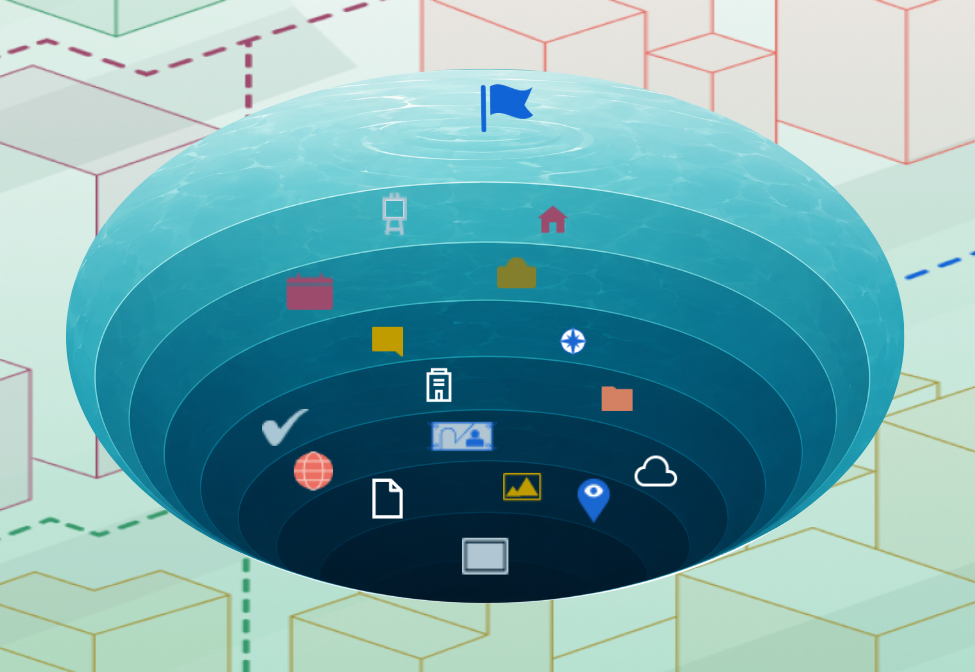
Shannon once told me that he liked some software work we were doing at the time because it made him think of a small pond that's infinitely deep. By this he means that like a metaphorical swimmer in that pond, who’s secure about always seeing full perimeter of the tight body of water, it’s good for someone using software to quickly & clearly ascertain what’s accessible for them in the moment, while also having confidence to probe deeper further descending like to pore over finer data or call up more specific features. I hope that powerful symbolism persuades and inspires reader of this post, with no mind paid to any more grisly, claustrophobic and, well, suffocating associations that could be made with descending in an infinitely deep, narrow pond.
The intended positive association of this small/deep-pond metaphor sticks with me as standard for good software product management. The few choices and details presented should directly address the most likely and/or prioritized live motivations, and if there’s an alternative driver it’s straightforward and efficient to get to the next most likely on-point resources, and so on. The concept especially resonates with a few of the advances in our latest There.App 1.14.0 release.
As There.App for on-location activities we prioritize place related considerations. Time zones are part of that. Activities in special places often involve at least some key participants taking at least some related steps remotely at least some of the time. If the Boston-based demo expert is to be available for online triage consulting during show hours in London, it’s good to confirm times work for parties on both sides of the ocean and we deliver that with emphasis on minimizing the related exploration, reading and tapping. We put a compact time-zone dialer next to everywhere time is presented to clarify association. How about that pond metaphor? The pond’s surface is collapsed form of the dialer just showing where the associated time zone is on top of a button. Then tapping its drop-down caret is, um, descending a bit, so hopefully you’ve got goggles and are looking across top layer of water – in our app that’s opening the button which pops above the most likely time-zone alternatives like where’s the device accessing the service live, or time zone of the headquarters for the project. And so now we’re holding our breath and diving down, as deep as I feel safe symbolically probing in a blog post – below is capability to select any time zone in the world, but we collapse menu at the continent level so everywhere fits at first glance instead of some interminable list of exotic names with unclear alphabetization, keeping contained small pond perspective even at this depth. And then opening any continent opens a few time zones within it selected to be comprehensive, recognizable, brief and consistent, along with presentation of the current time there to reassure selection. So someone who wants to look up something arcane can do that pretty straightforwardly and without accomodation of that getting in the way of more general usage where the initial time zone showing on top of the button surface shows what person needs to see, and there’s no deeper diving.

Writing that prior paragraph was torturous, metaphorically! Anyhow, I’m going to elaborate, hopefully more briefly and less arcanely, on a couple more examples of small/deep principle as realized in There.App release 1.14.0.
We’ve gotten a lot of requests for access controls to govern which people get what privileges related to certain contents within projects, often a matter of sensitivity in activities that have lots of different sorts of participants, from temp staffers to VIP clientele and many other categorizations in between. Other principles to which we aspire include skewing constructs towards openness presuming it's generally best for everyone on the team to be broadly informed and responsively supported by rich available capabilities. And we want to keep that pond small. So, while we now have access controls, we presume intent when contents are being added that this should be open and we minimize what’s conveyed to a green circle with open padlock. From there can mouse over for more of an explanation including the fact that tapping this green button switches to locked while springing out a drawer that presents the full team with capabilities to precisely control who has what level of access. Although, at a little less depth than what was just described there are also various sorts of bulk controls for access privileges to get things set up a little more quickly and coarsely.

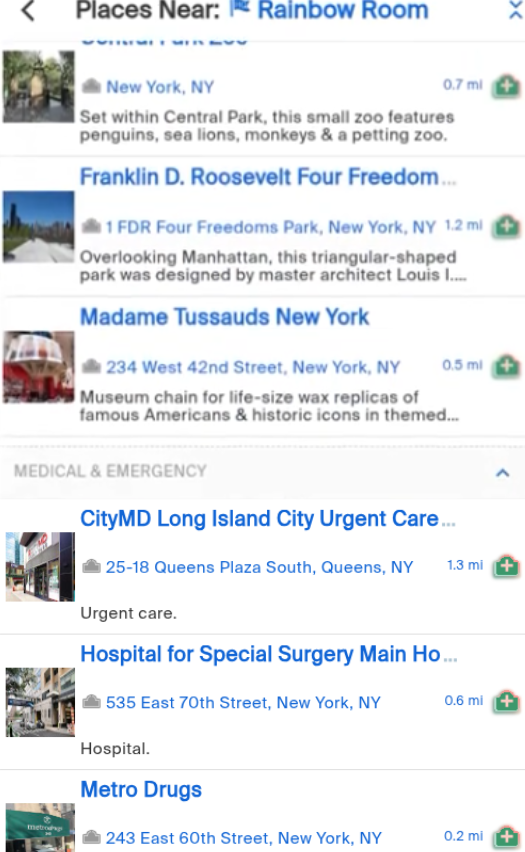
Phew that paragraph was a little crisper, but still a wrestling match for me to get written and perhaps for you to read too, sorry, and for what it’s worth I know how it feels. One more example of Shannon Newton’s small pond that’s infinitely deep maxim (a Newton’s Law?) influencing me to this day in our There.App 1.14.0 release is how we’re starting to avail AI functionality to fulfill another area of frequent requests which is for projects to get more rapidly and automatically built. Now, once a project has some metadata set like identifying its HQ site or start-to-end timing of main program, then some telltale diamond-shaped add buttons appear encouraging AI build. Tap one of buttons to metaphorically go deeper and there’s presentation of categories to add, in the case of places, six of them (food, hospitality, safety…). And a little deeper still can open any of those categories for specific mix of recommendations like in case of stores and services including copy shops, hair cutters and co-working spaces among a dozen or so options presented.
I feel like this whole post has been me struggling to clearly convey how There.App implements a pretty succinct concept. If you’ve read this far, wow. Anyhow, one last paragraph / opportunity to try rescuing a summary of the point: We’re for live and on-location activities with other people, and towards that we endeavor to maximize that real-world engagement, including streamlining-screen time. The notion of a small pond (attention focus on a few relevant and powerful capabilities likely to address current need), that’s infinitely deep (in cases of requiring more specific and/or sophisticated assistance there’s clear navigation to that) is a priority for us, and it shows in our solution evolution.
.png)


